Automated sales follow up is the use of software and AI to send timely, personalized outreach to prospects across email, SMS, phone, and LinkedIn — without manual effort from your team.
Here’s a quick answer to what it is and why it matters:
- What it is: A system that triggers follow-up messages based on lead behavior, deal stage, or elapsed time — automatically
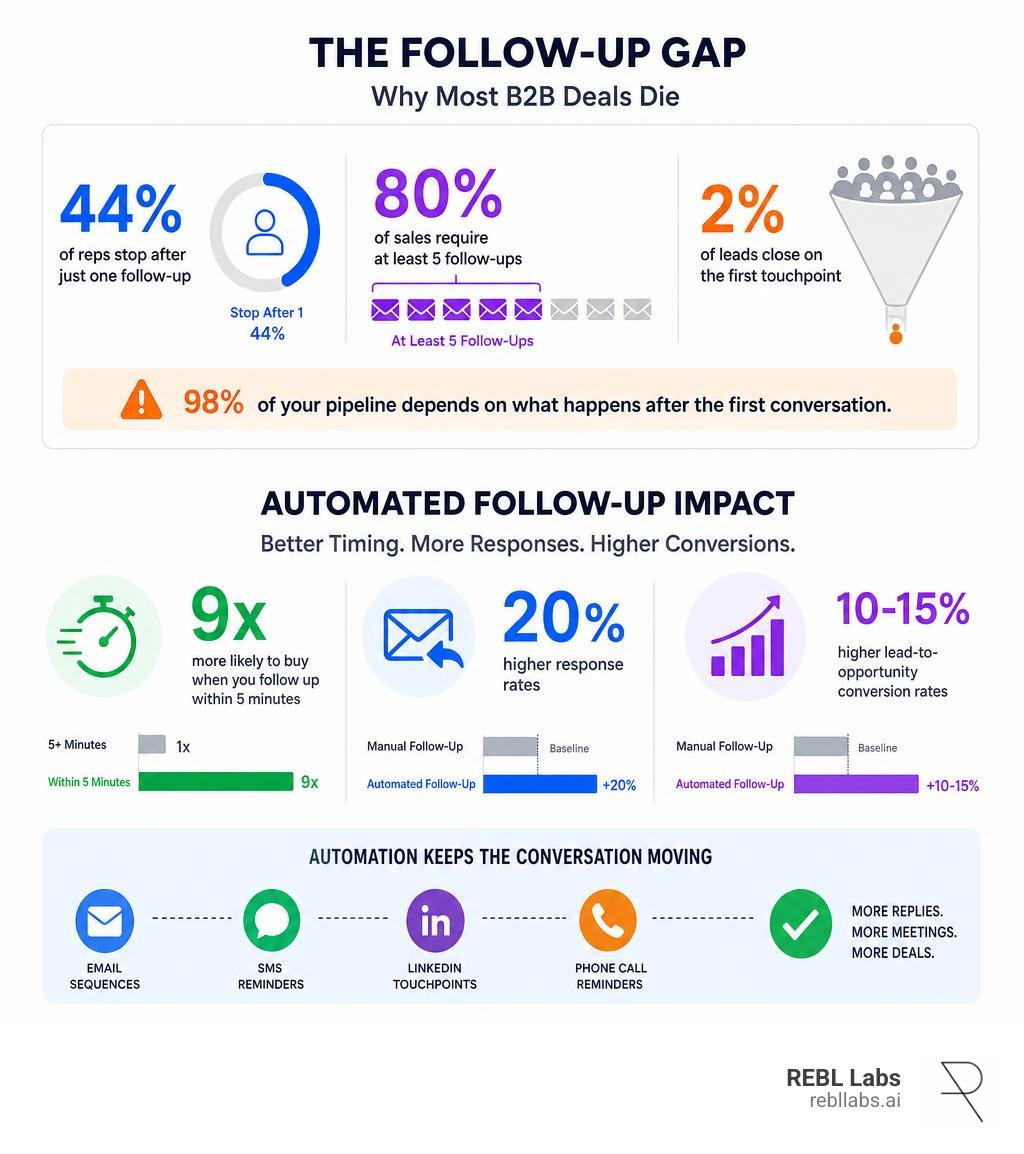
- Why it works: 80% of sales require at least 5 follow-up contacts, yet 44% of reps stop after just one
- Key benefit: Following up within 5 minutes makes a lead 9x more likely to buy — automation makes that speed possible at scale
- Core channels: Email sequences, SMS, LinkedIn touchpoints, and phone call reminders
- Bottom line: Companies using automated follow-up see 20% higher response rates and 10-15% higher lead-to-opportunity conversion rates
The hard truth is that most deals don’t die because your price is wrong or your product falls short. They die because someone forgot to follow up.
Only 2% of leads close on the first touchpoint. That means 98% of your pipeline depends entirely on what happens after the first conversation. For most B2B service teams managing a full workload, consistent follow-up is nearly impossible to do manually — leads go cold, momentum fades, and revenue quietly disappears.
The average sales rep spends only 28% of their time actually selling. The rest goes to admin work — including chasing down follow-ups that should have been sent days ago.
That’s the follow-up gap. And it’s likely the single biggest revenue leak in your pipeline right now.
I’m REBL Risty, and after 16 years running a B2B agency, I’ve seen how automated sales follow up transforms what’s possible for a lean team — it’s one of the core systems we built into our own REBL CRM to finally scale without adding headcount. In this guide, I’ll walk you through the tools, strategies, and frameworks that actually work.
Explore more about Automated sales follow up:
The Power of Automated Sales Follow Up in Modern Sales Pipelines
To understand why automated systems are dominating the B2B landscape in June 2026, we have to look at the stark contrast between manual and automated workflows.
Manual follow-up relies entirely on human memory, perfect calendar management, and sheer discipline. A rep must write down a reminder, log into their CRM, draft an email from scratch, check if the prospect replied on LinkedIn, and hit send. In reality, inboxes overflow, meetings run over, and reps focus on the loudest fires. This manual friction is why 44% of salespeople give up after just one follow-up, and a staggering 92% throw in the towel after four attempts.
Yet, industry data consistently proves that 80% of sales require at least five follow-up contacts after the initial meeting.
By transitioning to an automated system, you eliminate the cognitive load of remembering who to contact and when. Instead of letting leads rot in “stale thread” purgatory, software runs in the background to ensure every prospect receives a consistent, structured cadence. Businesses that implement sales automation within a year see an average of 15% revenue growth and 20% higher response rates.
Furthermore, the timing of your outreach dictates your success. Following up with inbound leads within five minutes makes them nine times more likely to buy. If you wait longer than seven days to follow up with a stalled opportunity, your response rates drop by 45%.
To capture this lost revenue, forward-thinking B2B organizations are turning to advanced outreach strategies. To learn how to structure your initial touchpoints, check out The Complete Guide to Automating Sales Outreach: Strategies & Tools for Success. For businesses running paid advertising, using a specialized lead-capture flow like Flawless Followup ensures that expensive marketing leads never slip through the cracks due to human delay.
Core Components and Multi-Channel Sequence Design

An effective automated sales follow up system is not just a single email drip campaign. It is a highly integrated, multi-channel engine designed to meet prospects wherever they are most active.
1. Trigger-Based Workflows
The foundation of any automation engine is the “trigger.” Instead of sending messages on static calendar dates, triggers launch sequences based on real-time prospect behavior. Common triggers include:
- A new lead filling out a website form
- A prospect opening a proposal document or clicking a pricing link
- A deal stage changing in your CRM (e.g., moving from “Demo Completed” to “Proposal Sent”)
- A specific period of inactivity (e.g., 5 days since the last email exchange)
2. Deep CRM Integration
Your automation tool must sync bi-directionally with your CRM. When a lead takes an action, the CRM updates instantly. Crucially, the sequence must automatically pause the second a prospect replies. There is nothing more embarrassing than sending an automated “Just checking in!” email to a client who booked a meeting with you ten minutes prior.
3. Multi-Channel Touchpoints
B2B buyers are bombarded with noise. To stand out, you must orchestrate your follow-ups across multiple channels:
- Email Sequences: The primary B2B communication channel. In fact, 81% of small and medium-sized businesses rely on email marketing as their primary channel for customer acquisition.
- SMS Outreach: Text messaging offers unmatched immediacy. People read 90% of text messages within three minutes of receipt. Using SMS for quick order updates, meeting reminders, or urgent notifications keeps your brand top-of-mind.
- LinkedIn Touchpoints: Crucial for professional services. Automating profile views, connection requests, and soft follow-up messages on LinkedIn helps warm up cold email threads.
- Phone and Voicemail Drops: Bringing voice into your sequences at scale ensures your outreach maintains a human touch without requiring hours of manual dialing.
To build a sequence that perfectly balances these channels without overwhelming your prospects, read our step-by-step blueprint: Set It and Forget It: Building Effective Automated Follow-Up Campaigns.
How AI and Modern Software Transform Follow-Ups

Historically, automated follow-ups had a major flaw: they sounded incredibly robotic. Prospects quickly caught on to generic templates stuffed with obvious mail-merge fields like {{first_name}} and {{company_name}}.
In 2026, generative AI and Natural Language Processing (NLP) have completely solved this bottleneck. Modern AI-powered follow-up tools analyze the context of your previous conversations, detect open questions, evaluate prospect sentiment, and draft hyper-personalized follow-up emails that read as if they were written by a dedicated human assistant.
AI-Driven Personalization at Scale
Instead of sending a generic “circling back” email, an AI agent can:
- Read the entire historical email thread
- Identify that the prospect was waiting on a specific case study or budget approval
- Cross-reference internal knowledge bases or websites to find the exact resource
- Draft a highly personalized response referencing those specific conversation details
This level of personalization receives 2-3x higher response rates than static templates. Tools like Mixmax even offer features like “Smart Send,” which analyzes when a specific recipient is most active in their inbox and schedules the follow-up for that exact window, driving open rates up to 67%.
To help you choose the right technology for your sales team, we have categorized the leading software options below:
| Category | Typical Platforms | Best For | Key Capabilities |
|---|---|---|---|
| CRM-Native Automation | Pipedrive, HubSpot, Salesforce, monday CRM | Teams wanting a single source of truth without adding extra tools. | Deal-stage triggers, automatic activity logging, native reporting dashboards. |
| AI-Native & Agents | Sai, Convin AI, Outsales, B2B Rocket | Lean teams looking to offload email drafting, call analysis, and booking. | NLP thread analysis, 24/7 AI calling agents, automatic CRM data enrichment. |
| Multichannel Outreach | Salesforge, FlowUp, Keap, Mixmax | High-volume outbound teams targeting email, SMS, and LinkedIn. | Smart branching, subsequence routing, SMS and voicemail drops. |
To dive deeper into how these modern AI tools work, explore our guides on Mastering AI Sales Follow-Ups for Busy Revenue Teams and see our curated list of Stop Leaking Cash with These AI Sales Assistants. If you are on a tight budget, we also maintain The Ultimate List of Free AI Follow-Up Email Tools for Sales.
Key Metrics and Overcoming Implementation Challenges
To ensure your automated sales follow up system is driving revenue rather than annoying your market, you must track the correct KPIs and proactively address common implementation hurdles.
Essential Metrics to Track
- Lead Response Time: The average time it takes to send the first follow-up after a lead is captured. Aim for under 5 minutes.
- Sequence Reply Rate: The percentage of enrolled prospects who reply to your sequence. Top performers achieve reply rates between 18% and 25%.
- Meeting Conversion Rate: The percentage of leads who book a meeting directly from a follow-up step.
- Pipeline Velocity: How quickly deals move from initial contact to closed-won. Automation typically reduces the average sales cycle length by 30%.
- Drop-Off Points: Identify which specific step in your 5-to-8 step sequence has the highest unsubscribe or non-response rate so you can optimize the copy.
Overcoming Common Implementation Challenges
1. Deliverability and Spam Issues
If you send too many automated emails too quickly from a new domain, your messages will land in the spam folder. To prevent this, implement SPF, DKIM, and DMARC records. Enforce global contact frequency caps to ensure you are not over-messaging prospects, and use “warm-up” features to gradually scale your outbound volume.
2. Employee Resistance
Sales reps often fear that automation will replace them or make their outreach look robotic. To overcome this, position automation as a “super-powered sidekick” that removes administrative dread. Focus on “human-in-the-loop” workflows where the AI drafts the follow-up, but the rep has the final review and approval before hitting send.
3. Data Privacy and Compliance
Ensure your automation workflows comply with local regulations such as GDPR, CCPA, and HIPAA. Always include a clear, single-click unsubscribe link in your emails, and limit your automated SMS outreach to local business hours (typically 8 AM to 9 PM in the recipient’s local time zone).
For sales leaders looking to manage this transition smoothly, our playbook on AI for Sales Managers provides actionable coaching frameworks.
Frequently Asked Questions about Follow-Up Systems
How do I set up an automated sales follow up sequence?
To set up an effective sequence, start by mapping out your current sales process. Identify your most common touchpoints and transition points. Next, centralize your lead data inside your CRM. Define clear trigger rules (such as “Form Submitted” or “Proposal Sent”) and build a multi-channel cadence using a visual sequence builder. Always include an auto-pause rule so that any reply or booked meeting instantly exits the prospect from the sequence.
What is the optimal timing for an automated sales follow up?
We recommend spacing your first three touchpoints 3 to 5 days apart. Sending follow-ups too quickly can feel aggressive, while waiting longer than 7 days drops response rates by 45%. For long-term nurture campaigns, space your educational, value-add touchpoints 14 to 30 days apart. Always utilize timezone-aware sending and business-hour constraints so your messages arrive when prospects are actively working.
Will automation replace human sales reps?
No. Automation is designed to handle repetitive, administrative logistics — like tracking down silent threads and drafting initial check-ins — so your reps can focus on what they do best. Sales will always be about building genuine human relationships, navigating complex negotiations, and addressing unique objections. Combining AI efficiency with human empathy is the ultimate recipe for modern sales success.
Conclusion
In the B2B landscape of 2026, letting hot leads go cold because of manual follow-up gaps is no longer an option. Implementing a robust, multi-channel automated sales follow up system ensures that your business stays top-of-mind, recovers lost pipeline revenue, and closes deals up to 50% faster.
At REBL Labs, we specialize in helping B2B professional service firms bridge the follow-up gap. Our AI-powered marketing and sales solutions act as 24/7 AI teammates that integrate seamlessly with your existing CRM, automate your most tedious follow-up sequences, cut administrative costs, and boost overall conversion rates — all with zero learning curve for your team.
Ready to stop leaking revenue and start closing more deals on autopilot? Explore our AI Sales Automation: Complete Guide to see how we can transform your pipeline today.
For additional specialized strategies, check out:

Meet REBL, the AI expert and CEO of REBL Labs AI. She’s the go-to AI authority who helps businesses navigate the future of marketing automation. Known for making AI approachable and actionable, REBL is a sought-after speaker in the AI space, turning complex tech into business wins. She’s here to ensure that every business can scale smarter, faster, and with zero guesswork.