AI marketing automation is the use of artificial intelligence to plan, execute, and optimize marketing tasks — without constant human input.
Here’s a quick breakdown of what it means and why it matters:
| Question | Quick Answer |
|---|---|
| What is it? | Software that uses AI to automate marketing tasks like email, ads, content, and lead nurturing |
| How is it different from traditional automation? | Traditional tools follow fixed rules. AI learns, adapts, and makes decisions on its own |
| Who is it for? | Businesses of any size that want to scale marketing without adding headcount |
| What can it do? | Personalize messages, optimize campaigns, generate content, and run workflows 24/7 |
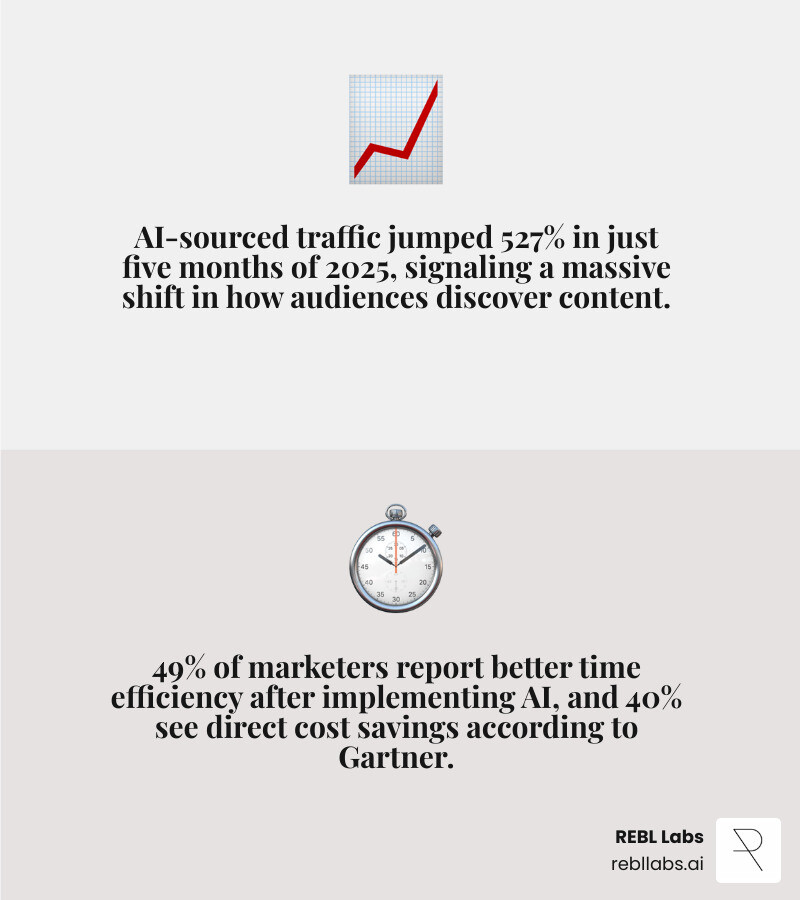
| Why does it matter now? | AI-sourced traffic jumped 527% in just five months of 2025. The shift is already happening |
If you run a professional services firm, you already know the pain: too many manual tasks, not enough hours, and a marketing function that doesn’t scale without hiring more people.
That tension is exactly why so many business leaders are looking at AI right now — not as a novelty, but as a practical way to do more with less.
The numbers back it up. According to Gartner, 49% of marketers report better time efficiency after implementing AI, and 40% see direct cost savings. At the same time, only 25% of marketing teams have an active AI implementation plan. That gap is an opportunity.
But here’s the thing: most of the advice out there treats AI marketing automation like a magic switch. It isn’t. Done wrong, it produces generic content, broken workflows, and a brand that feels like it was assembled by a robot.
Done right, it frees your team to focus on the work that actually requires a human — strategy, relationships, and creative judgment.
I’m REBL Risty, and I’ve spent the last three years building AI-powered marketing and sales systems inside my own agency after 16 years of doing it the hard way — manually. I’ve seen how AI marketing automation can double content output and make scaling feel sustainable without adding headcount.
Let’s walk through exactly how to do this without losing what makes your business human.
Basic AI marketing automation glossary:
What is AI Marketing Automation and How Does It Differ from Traditional Systems?
To truly appreciate where we are in July 2026, we have to look at how we got here. For years, marketing automation meant setting up rigid, sequential maps. If a user clicked Link A, we sent Email B. If they didn’t, we waited three days and sent Email C.
This traditional approach is entirely rule-based. It requires human marketers to anticipate every possible user path, build complex logic trees, and manually segment audiences. It is time-consuming, fragile, and doesn’t scale well when customer behavior changes.
AI-Driven Marketing Automation flips this model on its head. Instead of relying on static, pre-programmed rules, modern AI systems use predictive modeling, machine learning, and dynamic personalization to adapt in real time.
Instead of us telling the system exactly what to do at every turn, we give the AI a goal (like “maximize demo sign-ups”) and the guardrails to work within. The AI then analyzes incoming user data, predicts which content will perform best for each individual user, and dynamically adjusts the workflow on the fly.
| Feature | Traditional Marketing Automation | AI Marketing Automation |
|---|---|---|
| Core Logic | Rule-based (“If-This-Then-That”) | Predictive modeling & machine learning |
| Segmentation | Manual, static lists updated periodically | Dynamic, real-time behavioral clustering |
| Content Delivery | Static templates sent to broad groups | Dynamic personalization tailored to individuals |
| Optimization | Manual A/B testing requiring human analysis | Continuous, autonomous self-optimization |
| Scalability | High manual effort to build and maintain | Low manual effort; scales infinitely once set up |
The Evolution of Traditional Marketing Automation Tools
In the early days of digital marketing, Marketing Automation Tools were essentially glorified email dispatchers. They excelled at sending scheduled newsletters and tracking basic metrics like open rates and clicks.
As the technology matured, these platforms introduced lead scoring and multi-channel triggers. However, the underlying architecture remained the same: humans had to do the heavy lifting of analyzing data, building segments, and writing every single variation of an email sequence. If a campaign underperformed, a marketer had to manually dig through the analytics, form a hypothesis, design a new test, and execute it.
The Core Capabilities of Modern AI Marketing Automation
Today, the integration of advanced machine learning models has transformed these platforms into intelligent decision-making hubs. Modern AI Tools Marketing Automation systems process millions of data points in milliseconds to perform three core functions:
- Predictive Analytics: AI analyzes past consumer behavior to predict future actions—such as when a prospect is most likely to buy, or when a current client is showing signs of churning.
- Real-Time Optimization: Instead of waiting for a campaign to finish to run an A/B test, AI continuously shifts budgets, tweaks copy, and alters send times in real time to maximize performance.
- Dynamic Personalization: The system can change the actual copy, images, and layout of a landing page or email based on the specific industry, behavior, and intent of the visitor.
The Rise of Agentic AI and Autonomous Campaign Execution
We are currently living through a massive paradigm shift. We are moving away from “copilots” (AI tools that sit quietly on the sidelines waiting for us to type a prompt) toward Agentic AI—autonomous systems that can actively execute complex, multi-step marketing campaigns with minimal human intervention.
Implementing agentic systems is the ultimate key to Maximizing ROI in Marketing Automation. In the past, a marketer had to log into five different tools to research a competitor, draft an email, build a landing page, launch an ad campaign, and update the CRM. Today, agentic AI acts as the connective tissue, orchestrating these workflows autonomously.
From Copilots to Autonomous AI Marketing Automation Teammates
This transition means that instead of managing software, we are now managing “teammates.” At REBL Labs, our core focus is providing B2B professional service firms with 24/7 AI teammates that automate these exact marketing and sales tasks. Because these agents integrate directly into your existing systems, there is virtually zero learning curve for your human staff.
This shift is powered by technologies like Model Context Protocol (MCP), which allows large language models (LLMs) to connect directly to internal tools like your CRM, Webflow site, Google Drive, or Slack without needing custom, expensive API development. Combined with front-end prototyping tools like v0, marketers are transitioning into product managers. We are “vibe coding”—building entire landing pages, interactive tools, and automated sequences simply by describing what we want to an autonomous agent.
With this level of technology, you can truly Automate Your Marketing Without Writing a Single Line of Code.
Key Components of an Agentic Marketing System
To trust an AI agent to execute campaigns autonomously, it must be built on a robust, structured framework. An enterprise-grade agentic system relies on several core components:
- Memory: The system retains context from past interactions, customer histories, and previous campaign performances.
- Planning Engine: The AI breaks down a high-level goal (e.g., “generate 50 qualified B2B leads this month”) into a sequence of actionable steps.
- Tool Integration: The agent can read and write to your CRM, send emails, schedule social posts, and scrape competitor websites.
- Feedback Loops: The system constantly measures its own output against actual conversion data, refining its approach to improve future results.
Optimizing Content, SEO, and Personalization at Scale
Scaling content production has historically been a bottleneck for professional service firms. High-quality, authoritative content requires deep expertise, which is usually locked inside the heads of busy partners and senior consultants.
By utilizing Automated Content Creation workflows, we can extract that internal expertise through simple voice interviews or raw notes, and use AI to structure, draft, and optimize that content for multiple platforms simultaneously. This maintains the “soul” and unique perspective of your brand while removing the writing bottleneck.
Scaling Personalization with AI Marketing Automation
In B2B marketing, generic messaging is where campaigns go to die. Buyers expect you to understand their specific industry, pain points, and business size.
Using AI, we can scale this level of hyper-personalization without writing hundreds of individual emails. AI systems analyze real-time buying signals and dynamically tailor the timing, product recommendations, and messaging of your outreach. For a deep dive into how to set this up efficiently, check out The Lazy Marketers Guide to Boosting Results with AI.
Preparing for Generative Engine Optimization (GEO) and Conversational Search
The SEO landscape is undergoing its most radical transformation since the invention of the search engine. Traditional search volume is projected to drop by 25% by the end of 2026 as users shift to AI-powered conversational answer engines like ChatGPT, Claude, and Perplexity.
Furthermore, Google’s AI Overviews now appear in roughly 16% of all searches. This means your prospects are no longer just clicking links; they are asking conversational questions and reading synthesized answers.
To survive, we must transition from traditional SEO to Generative Engine Optimization (GEO). GEO is the practice of optimizing your digital footprint so that AI models cite and recommend your brand when answering user queries. According to Scientific research on search trends, AI-sourced web traffic jumped an astonishing 527% over a five-month period in 2025 alone.
To optimize for GEO:
- Focus on Information Gain: AI models ignore generic, regurgitated content. Publish unique data, proprietary frameworks, and deeply lived experiences.
- Use Structured Data: Ensure your website uses clear schema markup so AI crawlers can easily parse and verify your facts.
- Answer Directly: Structure your content to provide clear, authoritative answers to complex industry questions, making it easy for AI engines to extract and cite your brand.
Best Practices for Integrating AI into Your Marketing Processes
Integrating AI into your firm isn’t about buying every shiny new tool on the market. In fact, collecting AI tools like baseball cards without a clear strategy is a recipe for high software bills and disjointed customer experiences.

Instead, we recommend dividing your AI integration strategy into two distinct categories: internal operations and customer-facing experiences.
Streamlining Internal Operations and Workflows
The safest, highest-ROI place to start with AI is behind the scenes. By optimizing your internal workflows, you build team confidence and find immediate time savings without risking customer trust.
Using AI for Digital Marketing internally allows your team to automate tedious research and administrative tasks. For example, we use AI agents to perform automated sentiment analysis on client feedback, summarize lengthy industry reports, and monitor competitor movements. This keeps your strategic team informed and ready to act, without requiring hours of manual web scraping.
Enhancing Customer-Facing Experiences Safely
When you are ready to deploy AI to interact directly with your clients and prospects—such as through conversational website agents or automated social media messaging—you must prioritize data privacy and brand safety.
Always ensure your customer-facing AI Social Media and chat tools are trained on a closed, verified knowledge base of your brand’s approved materials. Implement strict guardrails to prevent the AI from hallucinating or sharing sensitive information. Most importantly, always maintain a clear, seamless pathway for a human team member to step in when a conversation requires human empathy or complex negotiation.
Frequently Asked Questions about AI Marketing Automation
How can small businesses start with AI marketing automation on a limited budget?
You don’t need an enterprise-level budget to benefit from AI. Start by standardizing a small, highly effective stack. Begin by building custom, brand-trained GPTs using a standard ChatGPT or Claude subscription to help draft outlines and social posts based on your existing case studies.
For execution, look into low-code automation tools like Zapier or Make to connect your lead forms directly to your CRM and email tools. To keep your online presence active without spending hours scheduling posts, you can easily set up Automated Social Media Posting workflows that distribute your core insights across platforms automatically.
What are the main ethical and data privacy concerns when using AI in marketing?
The biggest risks surround data compliance, consumer trust, and bias. Never upload proprietary client data or sensitive personal information into public, consumer-grade AI models that use your inputs for training.
As privacy laws tighten, a robust first-party data strategy is essential. Ensure your marketing automation platforms comply with global regulations (like GDPR and CCPA) and clearly communicate to your audience how their data is used to personalize their experience.
What skills do modern marketers need to stay competitive in 2026?
The role of the marketer has fundamentally changed. While traditional marketing fundamentals—like understanding human psychology, positioning, and strategy—remain critical, modern marketers must develop technical agility.
Key skills for 2026 include:
- Strategic Oversight: Knowing how to design and manage AI-driven workflows rather than just executing manual tasks.
- Prompt Engineering & Data Curation: Learning how to feed AI models clean, highly contextual data to get the best possible outputs.
- Vibe Coding & Prototyping: Utilizing natural-language tools to build landing pages, micro-tools, and custom workflows without waiting on a development team.
Conclusion
The future of marketing isn’t about replacing humans with robots. It’s about using technology to remove the friction of execution so your team can focus on what they do best: building real, trusted relationships with your clients.
At REBL Labs, we build human-centric AI systems specifically designed for B2B professional service firms. Our 24/7 AI teammates handle the heavy lifting of lead generation, nurturing, and campaign management—giving you the power of a full-scale marketing department with absolutely no learning curve.
Ready to scale your business without losing your soul? Explore how we can help you build your automated growth engine at REBL Labs AI Automation.

Meet REBL, the AI expert and CEO of REBL Labs AI. She’s the go-to AI authority who helps businesses navigate the future of marketing automation. Known for making AI approachable and actionable, REBL is a sought-after speaker in the AI space, turning complex tech into business wins. She’s here to ensure that every business can scale smarter, faster, and with zero guesswork.


