Why Modern Law Firm Marketing Is No Longer Optional
Modern law firm marketing is the practice of using digital channels — SEO, content, paid ads, social media, and automation — to attract and convert legal clients online, replacing the old reliance on referrals and word of mouth.
Here’s a quick breakdown of what it covers:
| Channel | What It Does | Time to Results |
|---|---|---|
| SEO | Drives organic search traffic | 3-6 months |
| Google Business Profile | Gets you found locally | 2-4 weeks |
| Content marketing | Builds trust and authority | Ongoing |
| Google Ads / PPC | Generates leads fast | Immediate |
| Online reviews | Converts browsers into clients | Ongoing |
| Social media | Builds visibility and referrals | Ongoing |
| Email marketing | Nurtures leads at low cost | Weeks |
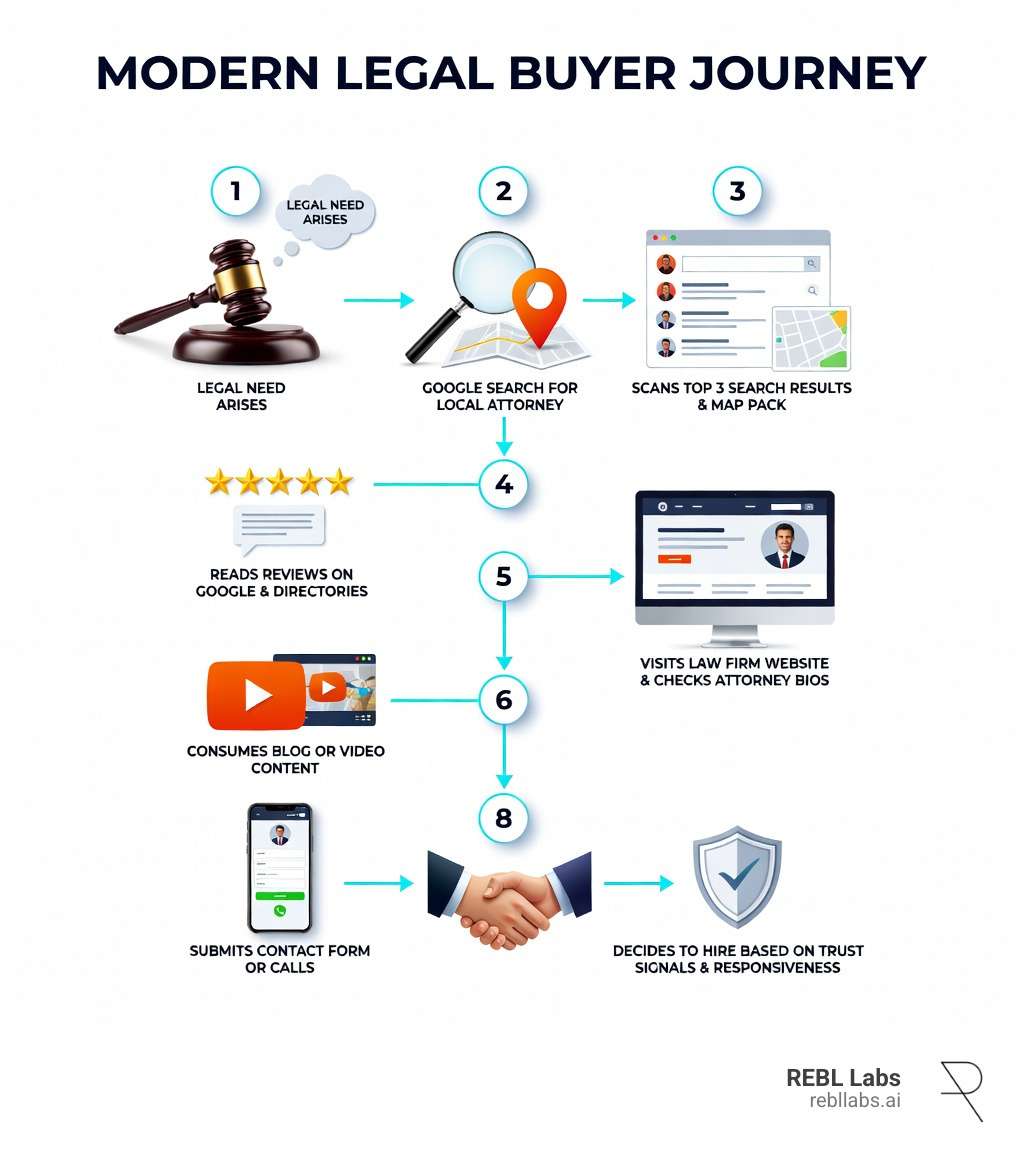
The legal industry has changed. Clients no longer ask a friend for a referral and stop there. Today, 96% of people use a search engine when looking for legal advice. They read reviews, browse websites, and compare attorneys long before picking up the phone.
Yet many law firms still market like it’s 2005 — relying on handshakes and Yellow Pages logic while competitors dominate Google search results.
The gap between high-growth and stagnant firms is stark. Firms that invest seriously in marketing grow at a median rate of 29.6%, more than three times faster than their peers. The ones that don’t? They’re often invisible to the very clients they’re trying to reach.
This guide will walk you through every component of a modern legal marketing strategy — from your website foundation to AI-powered automation — so you can build a system that brings in clients consistently.
I’m REBL Risty, and I’ve spent 16 years running a marketing agency, scaling it through every stage of growth using the same digital strategies I’ll share here — strategies that apply directly to modern law firm marketing in today’s AI-driven landscape. Let’s get into what actually works.
Simple guide to Modern law firm marketing terms:
The Core Components of Modern Law Firm Marketing
To move from the “Stone Age” of legal practice to becoming a “Digital Sage,” we must view marketing as an ecosystem rather than a series of one-off tasks. The 2022 ABA Legal Technology Survey Report highlights that 89% of firms now maintain a social media presence, signaling a massive shift toward digital-first interactions.
Modern marketing is built on three pillars: branding, a solid website foundation, and multi-channel integration. Branding isn’t just a logo; it’s the “heart” of your firm—the authenticity that connects with a client’s emotional needs. The website is the “head”—the logical structure that converts that connection into a consultation.
We also need to understand marketing terms like “conversion rate” and “landing pages” to speak the language of growth. High-growth firms don’t just “do marketing”; they take a client-centered approach, ensuring every touchpoint addresses the specific needs of their audience.

Building a Foundation with a Quality Website
Your website is your digital storefront. If it’s slow, confusing, or looks like it was built in 1998, potential clients will bounce faster than a rubber gavel. In the modern era, mobile responsiveness is non-negotiable. Research shows that over 58% of global website traffic comes from mobile devices. If a client can’t navigate your site on their phone while sitting in their car or a waiting room, you’ve already lost them.
User experience (UX) should focus on addressing a client’s pain points. Instead of a homepage that screams “We are the best lawyers,” try messaging that says “We understand the stress of your divorce, and we are here to help.” Every page should be a landing page designed to get the visitor to take a specific action, whether that’s booking a consultation or downloading a free guide.
Strategic Budgeting for Modern Law Firm Marketing
How much should you spend? The data is clear: you get what you pay for. High-growth law firms spend a median of 16.5% of their revenue on marketing. In contrast, firms with no growth spend only about 5%. This isn’t just about throwing money at the wall; it’s about investing in techniques that work, such as SEO and high-quality content.
To ensure your budget isn’t wasted, we recommend setting SMART goals. Your marketing objectives must be Specific, Measurable, Achievable, Relevant, and Time-bound. For example, “Get 10 new personal injury leads per month via our website by Q4” is a SMART goal. “Get more clients” is just a wish.
| Firm Category | Median Marketing Spend (% of Revenue) | Median Growth Rate |
|---|---|---|
| High Growth | 16.5% | 29.6% |
| Average Growth | 13.2% | 8.2% |
| No Growth | 5.0% | 0.0% |
Dominating Search: SEO and Local Visibility
If you aren’t on the first page of Google, you basically don’t exist. With 96% of people using search engines to find legal advice, Search Engine Optimization (SEO) is the cornerstone of Modern law firm marketing.
Google prioritizes content that follows E-E-A-T principles: Experience, Expertise, Authoritativeness, and Trustworthiness. This is especially true for law firms, which fall under Google’s “Your Money or Your Life” (YMYL) category. For more insights, check out this More info about AI-powered marketing.
Key Strategies for Modern Law Firm Marketing SEO
SEO is a “living, breathing thing” that requires constant adjustment. It starts with keyword selection. You shouldn’t just target broad terms like “lawyer.” Instead, focus on long tail keywords like “probate attorney in [Your City]” or “what to do after a car accident in [State].”
Using tools like Yoast SEO can help you optimize your on-page content. You should also incorporate semantically similar variations of your primary keywords. This signals to Google that your page is a comprehensive resource on the topic, not just a keyword-stuffed placeholder. Finally, building high-quality backlinks from reputable legal sites and local news outlets will boost your domain authority.
Local SEO and Google Business Profile
For most law firms, the “Map Pack” (the top three local results on Google) is the holy grail. To get there, you must claim and optimize your Google Business listing.
Key local SEO factors include:
- NAP Consistency: Ensure your Name, Address, and Phone number are identical across the web, from your website to your bar association profile.
- Proximity: Google prioritizes firms physically located near the searcher.
- Reviews: A high volume of positive, recent reviews is a massive ranking signal.
- Local Service Areas: Clearly define the geographic areas you serve to appear in “near me” searches.
Content, Social Proof, and Paid Acceleration
Content is how you demonstrate expertise before a client ever meets you. Currently, about 37% of law firms have a blog, and a third of them report that clients have retained them specifically because of their content. This is where More info about AI marketing solutions can help streamline your content creation process.
Leveraging Video and Social Media
Video is the most underutilized tool in the legal kit. While only 30% of firms producing videos currently, those that do see a massive advantage. Websites with video are 53× more likely to hit Google’s first page.
On the social media front, LinkedIn is the king of professional networking. Every attorney in your firm should have a well-branded LinkedIn profile, complete with a professional headshot. If you need tips on looking the part, check out these strategies for Best LinkedIn Profile Pictures.
Reputation Management and Online Reviews
Reviews are the single most influential factor in a client’s hiring decision. The vast majority (93%) of customers won’t make a purchase—or hire a lawyer—without reading reviews first.
We recommend building a “feedback loop” where you automatically ask satisfied clients for a review at the close of their case. Managing your reputation also means responding to negative reviews professionally and ethically, showing potential clients that you care about the client experience.
Paid Advertising: Google Ads and PPC
If you need leads today, Pay-Per-Click (PPC) advertising is the answer. Google Ads for lawyers can see conversion rates between 3.75% and 6.98%. While SEO is a marathon, PPC is a sprint.
To maximize your ad spend:
- Use highly specific landing pages for each ad group.
- Implement retargeting ads to stay top-of-mind for people who visited your site but didn’t call.
- Incorporate video on your landing pages; it can lead to 80% higher conversion rates.
Measuring Success and Emerging Trends
You can’t improve what you don’t measure. Modern firms use website tracking and Google Analytics to see exactly where their leads are coming from. If you’re new to this, Google offers a free course on how to install it on your site. For a deeper look at the tech side, see More info about AI in legal practice.
AI and the Future of Legal Marketing
AI is no longer science fiction; it’s a competitive necessity. From chatbots that handle initial client intake to predictive analytics that tell you which cases are likely to be most profitable, AI is transforming the field.
One of the most powerful uses of AI is in personalized outreach and communication. Statistics show that clients retain 95% of a message delivered via video compared to just 10% via text. AI can help you scale this kind of personalized content. Additionally, tools like a comprehensive guide to answering services for law firms show how automation can improve the client experience by ensuring no lead goes unanswered.
Integrating Multiple Marketing Channels
The most successful firms create an “omnipresence.” They don’t just do SEO; they combine it with email marketing, which offers a high ROI of $42 for every $1 spent. They also maintain strong referral programs and traditional networking. As 16 lawyers share their best marketing tips, the consensus is clear: a diversified strategy is a resilient strategy.
Frequently Asked Questions about Modern Law Firm Marketing
What is the ideal marketing budget for a law firm?
While the U.S. Small Business Administration suggests 7-8% of gross revenue, our research shows that High Growth firms—those growing at 20% or more annually—invest a median of 16.5%. If you are in a “No Growth” phase, you are likely spending closer to 5%. To scale, you must bridge that gap and invest in proven digital channels.
How long does it take to see results from SEO?
SEO is a long-term investment. Typically, it takes 3 to 6 months to see significant movement in rankings and organic lead volume. This timeline depends on keyword competition and the consistency of your content production. For immediate leads while your SEO matures, we recommend a balanced approach including PPC. You can read more about this timeline in this guide to Law Firm Marketing.
When should a law firm hire a specialized marketing agency?
You should consider hiring an agency when the “time suck” of doing it yourself begins to interfere with your billable hours. Marketing is a full-time job that requires specialized knowledge of algorithms, compliance, and data analysis. If you have an expertise gap or need to scale quickly, an agency can provide the systems you need. For more inspiration, explore 18 powerful marketing ideas for law firms of any size.
Conclusion
The shift from Stone Age referrals to the Digital Sage era of Modern law firm marketing is a journey of strategic integration. By building a high-performance website, dominating local search, and leveraging the power of social proof and AI, your firm can achieve predictable, sustainable growth.
At REBL Labs, we provide the AI-powered marketing and sales solutions that professional service firms need to stay ahead. Our 24/7 AI teammates are designed to automate your most tedious tasks, cutting costs while boosting revenue with virtually no learning curve. Don’t let your firm get left behind in the analog past. More info about AI-driven marketing automation is just a click away. Let’s build your digital future together.

Felipe Rezende is REBL Labs’ marketing and AI strategist with over 15 years of experience turning B2B challenges into scalable growth stories. Known for delivering real results—like a 40x boost in organic impressions—he blends a strategic, execution-driven approach with global marketing expertise in three languages. Felipe makes AI and automation feel like second nature, ensuring REBL Labs stays ahead of the curve.


