Sales consulting is a professional service that helps businesses improve how they sell — covering strategy, process, people, and technology to drive measurable revenue growth.
Quick answer for busy leaders:
| What it is | What it does | Who it’s for |
|---|---|---|
| Expert advisory on sales strategy and process | Fixes stagnant growth, poor forecasting, and scaling problems | B2B companies at any growth stage |
| Talent and organizational alignment | Aligns your team, tools, and culture around revenue goals | Founder-led firms scaling past manual sales |
| Go-to-market strategy and execution | Maps buyer journeys, segments markets, optimizes channels | Teams with inconsistent or plateauing pipeline |
| AI and digital sales transformation | Automates admin, improves forecasting, accelerates deals | Organizations modernizing their sales engine |
Most B2B leaders know their sales results could be better. They just aren’t sure why performance is stuck — or where to start fixing it.
The reality is that modern buyers have changed dramatically. Research from McKinsey & Company shows that 80% of B2B buyers want to engage with sales reps who act as trusted advisors, not product pitchers. Yet most sales teams are still running the same playbooks they used five years ago.
At the same time, sales reps are spending roughly three minutes on administrative tasks for every one minute they spend actually talking to customers. That’s not a people problem. That’s a systems and strategy problem — exactly what sales consulting is designed to solve.
The stakes are real. Companies that master modern digital sales principles gain, on average, a 3% EBITDA margin advantage over their competitors. And 98% of clients working with structured sales consulting engagements report a revenue increase within the first year.
This guide breaks down everything you need to know — from what sales consulting actually is, to how AI is reshaping engagements, to how to pick the right partner for your firm’s stage and budget.
I’m REBL Risty, and after 16 years running a B2B agency and hitting the same growth ceilings over and over, I’ve seen how the right sales consulting approach — especially when paired with AI and automation — can completely change what’s possible. I’ll share what I’ve learned throughout this guide.
What is Sales Consulting?
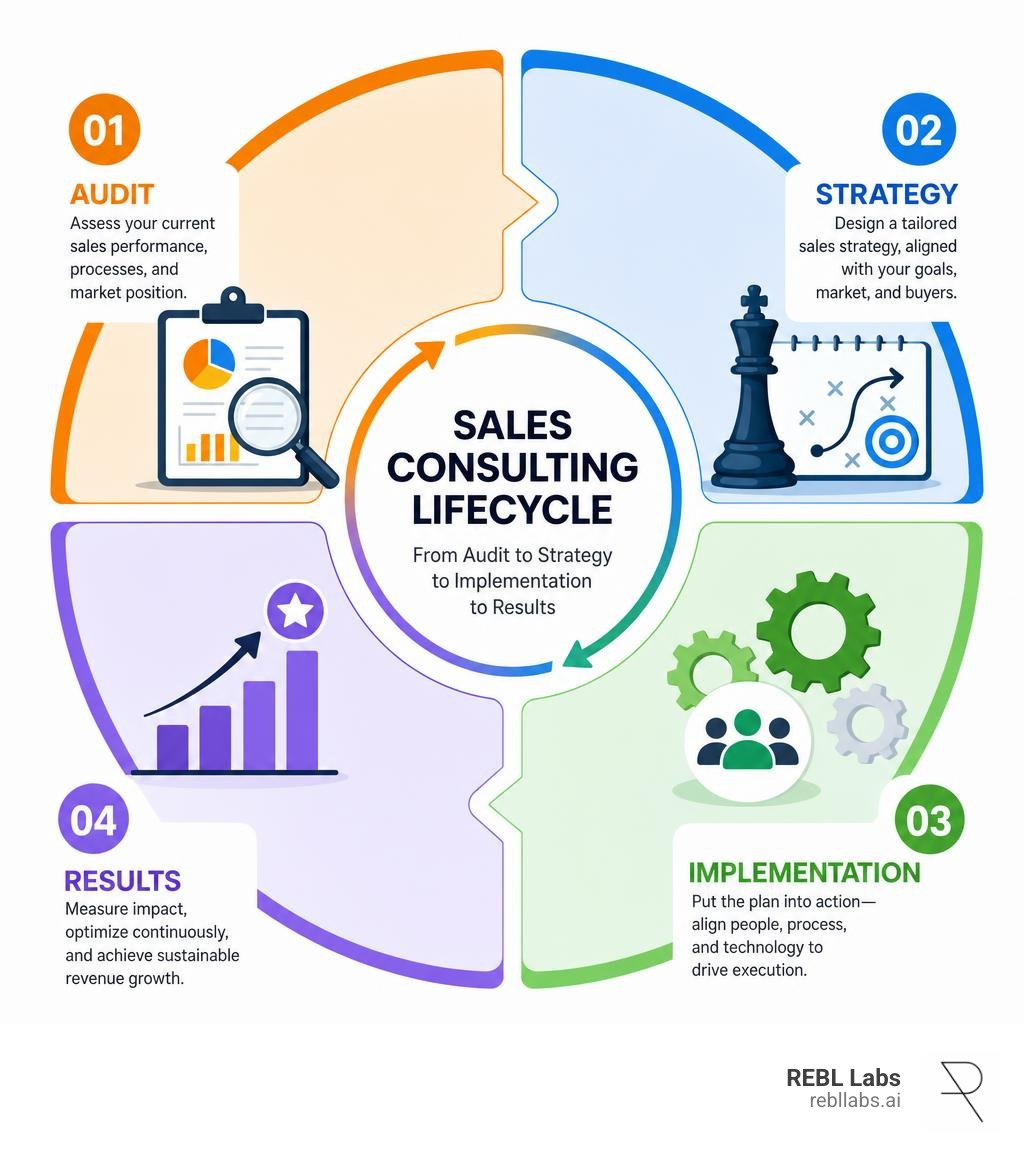
At its core, sales consulting is the process of diagnosing, designing, and optimizing an organization’s revenue engine. While many business owners assume it is just another name for motivational sales training, true consulting takes a holistic look at how your business goes to market.
To understand why this is so valuable, we must look at The Power of Partnership: How Sales Consulting Transforms Business. When you partner with a specialized sales consultant, you are not just hiring someone to tell your reps to “smile and dial” with more intensity. You are hiring an architect to rebuild the blueprint of your entire sales organization.
This blueprint requires an intense focus on three key pillars: people, process, and culture.
- People: Ensuring you have the right talent in the right seats, guided by clear roles and objective profiles.
- Process: Structuring the exact steps a lead takes from initial discovery to a closed contract, removing any friction or leaks.
- Culture: Aligning incentives, accountability, and leadership styles to foster a high-performance, customer-centric environment.
Unlike general management consulting — which looks broadly at corporate finance, legal structures, or high-level operations — sales consulting is laser-focused on commercial strategy and direct revenue generation. It is about closing the gap between how modern buyers actually want to buy and how your sellers are currently trying to sell.
Distinguishing Consulting from Sales Training
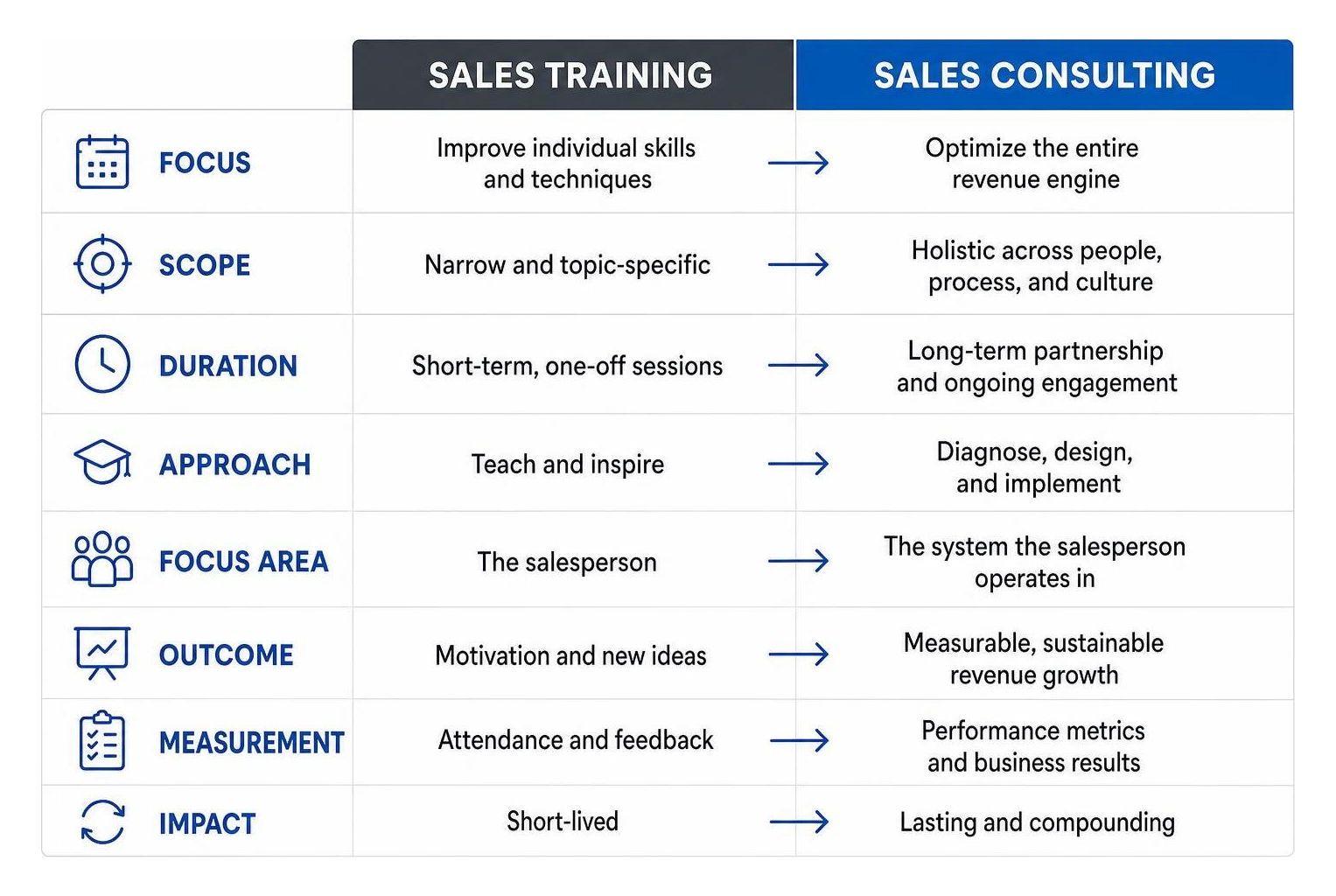
A common point of confusion is the difference between hiring a sales consultant and booking a sales training workshop. Let’s clear that up.
Traditional sales training is typically an isolated, one-off event. A charismatic trainer teaches your team a closing technique, a fresh script, or a new pitch deck. It’s highly motivational, but the excitement usually fades within a couple of weeks, and your team defaults back to their old habits.
Sales consulting, on the other hand, is a deep systemic intervention. It uses behavioral psychology and operational data to build custom Standard Operating Procedures (SOPs) and tracking systems. It focuses on long-term behavior change by embedding new methodologies directly into your daily workflows.
For instance, rather than simply teaching a methodology like Challenger or MEDDPICC in a classroom, a consultant will integrate these qualification criteria directly into your CRM. Sellers receive real-time guidance and reinforcement at the exact point of sale. If you want to truly elevate your team’s approach, you have to look Beyond the Pitch: Elevating Your B2B Sales Game.
Common Pain Points Solved by Sales Consulting
How do you know when it’s time to call in an expert? Most companies don’t seek out sales consulting when things are going perfectly. They reach out when they hit a painful wall. Some of the most common triggers include:
- Stagnant or Declining Growth: Your revenue has plateaued, and doing more of the same isn’t moving the needle.
- Poor Forecasting and Pipeline Visibility: Leadership is constantly surprised by missed targets at the end of the quarter because the pipeline is based on rep “gut feelings” rather than data.
- Scaling Bottlenecks: What worked when you were a five-person team is completely breaking now that you are trying to manage fifteen or fifty reps.
- The “Feast or Famine” Utilization Swing: In professional services, partners stop prospecting because they are too busy delivering client work, leading to a massive pipeline drought the next quarter.
By diving deep into these exact bottlenecks, consultants help you establish repeatable, predictable systems. For a closer look at these operational bottlenecks, check out The No-Nonsense Guide to Modern Sales Efficiency Solutions.
Core Services and Go-to-Market Strategies
When you engage a top-tier sales consulting practice, they don’t just hand you a generic slide deck. They roll up their sleeves to design a comprehensive commercial strategy. This begins with a deep dive into your Go-to-Market (GTM) strategy.

To build a high-performing revenue engine, you must align several core services:
- Operating Model Design: Redesigning your sales structure, channel coverage, and reporting lines to deploy your most qualified resources to areas with the highest revenue potential.
- Market and Customer Segmentation: Dividing your addressable market into clear, actionable segments based on customer lifetime value (LTV), customer acquisition cost (CAC), and strategic fit.
- Channel Strategy: Deciding the optimal mix of direct field sales, inside sales, digital self-service, and channel partners to reach those segments cost-effectively.
- Customer Journey Mapping: Mapping out every single touchpoint your buyer has with your brand, aligning internal sales stages directly with the buyer’s natural decision-making process.
By optimizing these factors, you can dramatically Improve Sales Efficiency: The Secret Sauce for High-Growth Teams. For example, a global biopharma company integrated advanced analytics, marketing, and inside sales to increase annual sales by $45 million in just 15 months, while simultaneously doubling its sales conversion rates.
Talent Strategy and Success Profiles
Your strategy is only as good as the people executing it. This is why modern sales consulting places a massive emphasis on talent strategy.
Instead of relying on subjective interviews or resume keywords, world-class organizations use data-centric Success Profiles to define, assess, and develop sales roles. A Success Profile outlines the exact skills, behavioral traits, and experiences required to succeed in a specific commercial role at your company.
Once these profiles are built, consultants conduct objective talent assessments to evaluate your existing team. This helps identify skill gaps, determine who has the potential to transition into leadership, and design highly targeted sales enablement and compensation programs.
By aligning compensation plans with your broader business objectives, you incentivize the right behaviors — like securing long-term recurring contracts rather than chasing quick, low-margin transactions.
The Role of AI and Digital Tools in Modern Engagements
We are living in a historic era of commercial disruption. In July 2026, we are seeing that the old ways of selling simply cannot compete with modern, tech-enabled sales engines.
Today, sales consulting is heavily focused on digital sales transformation, integrating advanced CRM platforms, Revenue Operations (RevOps) frameworks, and AI.

AI is no longer just a buzzword; it is actively transforming how B2B teams operate. In fact, research shows that 81% of sales teams are currently using or experimenting with AI in the B2B space.
By automating administrative tasks, generative AI allows your reps to spend less time on manual data entry and more time doing what they do best: building human relationships. To understand how this works in practice, explore our detailed guide on AI for B2B Sales.
Furthermore, the rise of agentic AI (intelligent AI agents) is allowing companies to automate complex, multi-step workflows. These agents can monitor buyer intent signals, update CRM records in real-time, and even draft hyper-personalized follow-up sequences based on a prospect’s recent LinkedIn activity.
AI-Driven Sales Strategy and Automation
When we look at the cutting edge of modern sales, strategic consulting must be paired with immediate execution capacity. This is where an AI-Driven Sales Strategy becomes a game-changer.
By implementing intelligent automation, B2B organizations can scale their outreach without sacrificing personalization. Top-performing prospectors who leverage AI to customize their messaging generate 2.7x more conversions and 1.8x more high-quality outcomes than those who rely on generic, volume-based templates.
From automating initial lead qualification to deploying conversational AI to handle early-stage inquiries, technology acts as a massive productivity accelerator. To learn how to build this capability step-by-step, check out The Complete Guide to Automating Sales Outreach: Strategies & Tools for Success.
Choosing the Right Sales Consulting Partner
As you look to hire a sales consultant, you will quickly find that the market is highly fragmented. To help you navigate your options, we’ve broken down the three primary categories of consulting partners:
| Partner Type | Typical Engagement Model | Best For | Key Considerations |
|---|---|---|---|
| Global Firms | Large-scale strategy, multi-country rollouts, heavy data benchmarking | Enterprise organizations undergoing massive digital transformations | High cost; can sometimes feel like a “cookie-cutter” template |
| Boutique Practices | Highly customized, niche industry focus, deep process design | Mid-market companies looking for tailored, strategic playbooks | Limited global scale; heavily dependent on the specific principal consultant |
| Fractional Leaders | Part-time, hands-on leadership (acting as an outsourced VP of Sales) | Founder-led SMBs transitioning away from founder-led sales | Great for building foundational infrastructure, but limited execution capacity |
If your pipeline is dry, your first instinct might be to hire a traditional agency to make more cold calls. However, modern buyers are increasingly resistant to cold outreach. Before you invest in traditional outbound methods, we highly recommend you Stop Cold Calling and Start Automating Your Sales Outreach.
For B2B professional service firms, the sweet spot is often a partner that can combine strategic advisory with practical, AI-driven automation tools. This allows you to build a scalable sales engine without the massive overhead of a traditional, multi-million dollar global consulting firm.
Measuring the ROI of Sales Consulting
Hiring a consultant is a significant investment, and you should expect clear, quantifiable results. Top-performing sales organizations track success using concrete metrics:
- Win Rates: Top-performing sellers achieve a 72% average win rate on proposed sales, compared to just 47% for average sellers. A successful consulting engagement should actively close this gap.
- Sales Productivity: Reducing administrative drag to increase active selling time.
- EBITDA Margin: Scaling revenues while optimizing operational costs, aiming for that 3% EBITDA margin advantage enjoyed by digital sales leaders.
- Revenue Growth: Achieving consistent, year-over-year growth.
To understand how to measure and track these metrics across your entire funnel, read Your Guide to AI-Powered B2B Sales Automation: From Forecasts to Funnels.
Frequently Asked Questions
How long does it take to see results from an engagement?
While deep organizational transformations can take several months, most businesses see measurable, early-stage improvements within the first 30 to 60 days.
This is typically driven by upfront pipeline diagnostics and “quick wins,” such as cleaning up stagnant deals in the CRM or refining outreach messaging. Significant, sustainable revenue impact usually emerges around the 90-day mark, as new processes and behaviors become standardized.
How do consultants help organizations navigate industry disruption?
Consultants help businesses transform into “omnichannel champions.” By analyzing shifting buyer behaviors, they help you design agile sprints to test new sales ideas directly in the market before scaling them up.
They ensure your team is trained in modern digital sales principles, allowing you to engage buyers across multiple online and offline channels seamlessly.
Can external advisors work alongside an internal sales enablement team?
Absolutely. In fact, this is often the most successful model. An external sales consultant brings fresh, research-backed perspectives and objective data benchmarks to diagnose deep process issues.
They design the new methodologies, custom trackers, and CRM tools, while your internal sales enablement team takes ownership of daily reinforcement and long-term behavioral coaching.
Conclusion
Finding effective sales consulting is about finding a partner that understands both the timeless psychology of selling and the cutting-edge power of modern technology.
At REBL Labs, we provide AI-powered marketing and sales solutions specifically designed for B2B professional service firms. Our unique approach offers you 24/7 AI teammates that automate routine tasks, qualify leads, and boost your revenue — all with zero learning curve and no expensive executive overhead.
If you are ready to transition away from manual, inconsistent sales processes and build a predictable, automated revenue engine, explore how we can support you by reading The Power of Partnership: How Sales Consulting Transforms Business. Let’s work together to turn your prospects into predictable profits.

Meet REBL, the AI expert and CEO of REBL Labs AI. She’s the go-to AI authority who helps businesses navigate the future of marketing automation. Known for making AI approachable and actionable, REBL is a sought-after speaker in the AI space, turning complex tech into business wins. She’s here to ensure that every business can scale smarter, faster, and with zero guesswork.


