Why Manual Sales Outreach Is Costing You Deals in 2026
B2B sales automation tools are software platforms that replace repetitive, manual sales tasks — like data entry, lead research, follow-up emails, and CRM updates — so your team can focus on closing deals.
The top B2B sales automation tools in 2026 include categories like:
- Data Enrichment Platforms: For compliant contact data and prospecting.
- All-in-One CRMs: For integrated outreach and lead management.
- AI-Powered Sequencing: For automated prospecting and follow-ups.
- Multichannel Outreach Tools: For LinkedIn and email lead generation.
- Conversation Intelligence: For call analysis and revenue forecasting.
- Sales Engagement Platforms: For AI-driven coaching and cadences.
- No-Code Workflow Automation: For connecting disparate systems.
- Social Prospecting Tools: For identifying intent signals on professional networks.
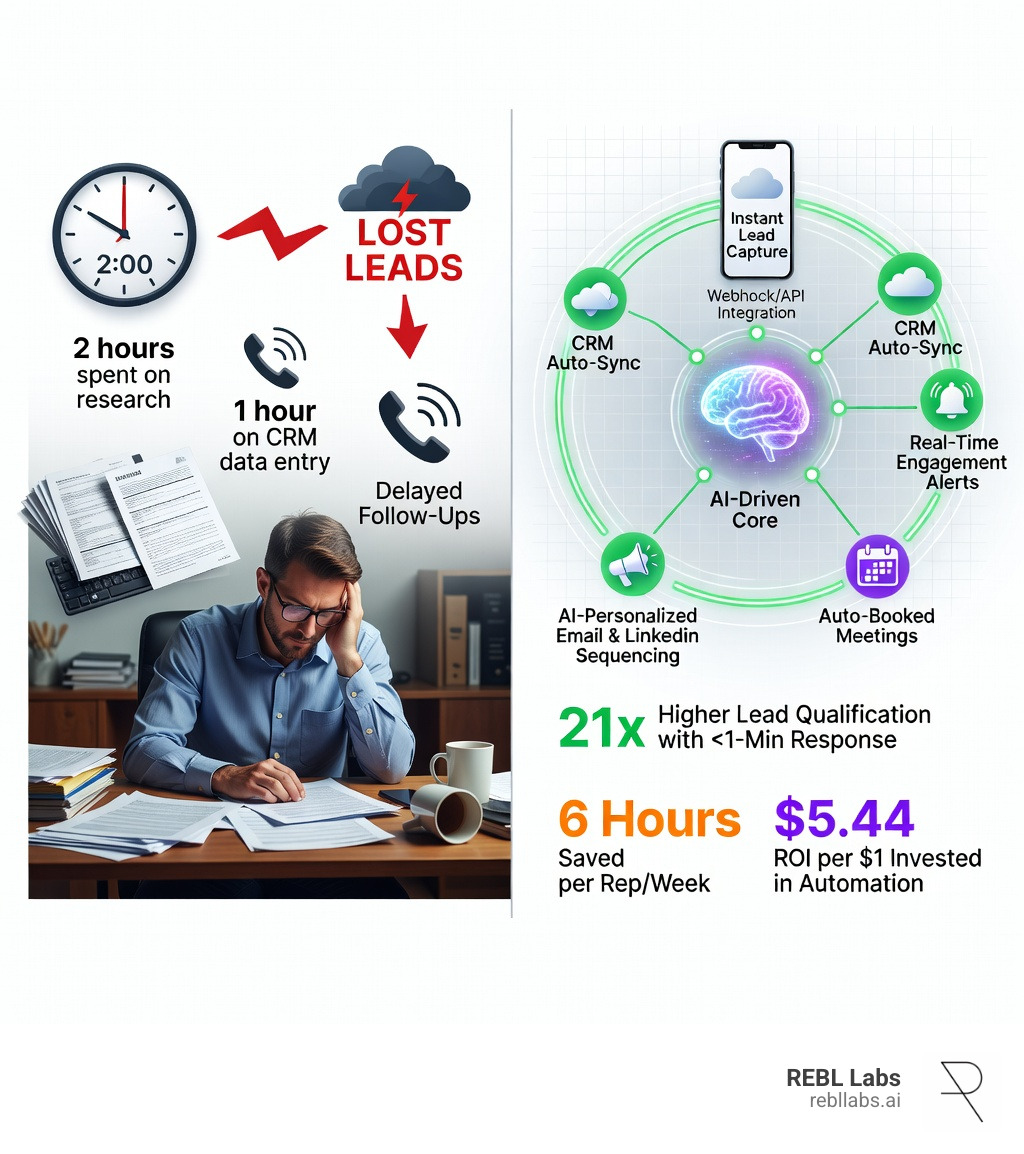
Here’s the reality most B2B sales leaders recognize immediately: your reps are spending the first two hours of every day on research and manual CRM data entry — before they’ve talked to a single prospect.
That’s not a people problem. That’s a process problem.
B2B sales is harder now than it was even two years ago. Buyers are more informed, inboxes are more crowded, and response rates on cold outreach are shrinking. At the same time, the pressure to hit pipeline targets keeps going up — without adding headcount.
The teams pulling ahead aren’t working harder. They’re automating smarter.
Sales automation removes the busywork — the copy-pasting, the manual follow-ups, the forgotten tasks — and replaces it with systems that run in the background while your reps focus on actual selling.
And the numbers back it up. You’re 21 times more likely to qualify a lead if you respond within the first minute. Automation makes that response time possible at scale.
I’m REBL Risty, and I’ve spent the last 16 years running a marketing and sales agency — so I know how much time gets lost to manual processes before B2B sales automation tools changed the way we work. In this guide, I’ll walk you through exactly which tools to use and how to build a system that scales without burning out your team.
What is B2B Sales Automation and Why It Matters in 2026
At its core, B2B sales automation is the use of software and AI to manage and execute repetitive tasks across the sales cycle. We aren’t just talking about sending a “personalized” email that says “Hi [First_Name].” Modern automation handles everything from finding a prospect’s direct phone number to predicting which deals in your pipeline are most likely to close this month.
The landscape has shifted dramatically. According to Gartner research, 61% of B2B buyers now prefer a rep-free buying experience. They want to research, evaluate, and sometimes even purchase through digital self-serve channels before they ever speak to a human. This means your sales process needs to be invisible, helpful, and lightning-fast.
B2B vs. B2C Sales Automation
While B2C automation is often about high-volume speed (think: “You left this shirt in your cart!”), B2B sales automation is about context and relationship support. B2B deals involve multiple stakeholders, longer sales cycles, and higher price points. Therefore, our automation needs to be more sophisticated, using AI for B2B Sales to provide value at every touchpoint.
The 60% Rule
Gartner predicts that by 2030, 60% of all sales tasks will be automated. If you’re still manually logging calls or spending hours building lead lists in Excel, you’re essentially trying to win a Formula 1 race on a bicycle. Companies leveraging advanced B2B sales automation tools are seeing an average ROI of $5.44 for every dollar spent.
| Feature | B2B Sales Automation | B2B Marketing Automation |
|---|---|---|
| Focus | Individual rep productivity & deal closing | Lead generation & top-of-funnel nurturing |
| Key Tools | CRM, Sales Engagement, Dialers | Email Marketing, Social Scheduling, CMS |
| Goal | Move leads from MQL to Closed-Won | Turn cold traffic into MQLs |
| Human Touch | High (supports the rep’s direct outreach) | Low (reaches many people at once) |
Key Benefits of Implementing B2B Sales Automation Tools
If you’re on the fence about investing in a new tech stack, let’s look at the cold, hard benefits. We’ve seen teams transform from “struggling to stay afloat” to “revenue machines” just by fixing their AI Sales Automation.
- Lightning-Fast Lead Response: As mentioned, you are 21x more likely to qualify a lead if you respond within 60 seconds. Automation tools can route a lead from a web form to a rep’s phone instantly, ensuring you never miss a hot prospect.
- Massive Time Savings: The average rep saves about 6 hours per week when they stop manual data entry. That is nearly a full workday returned to them to actually sell.
- Predictable Pipeline Velocity: When follow-ups are automated, nothing falls through the cracks. You can use advanced analytics to analyze real-time buyer engagement and predict revenue with precision, highlighting risks before they become lost deals.
- Personalization at Scale: AI doesn’t just insert a name; it can research a prospect’s recent LinkedIn post or a company’s latest funding round and weave that into an outreach sequence. This leads to a 250% higher response rate compared to generic templates.
- Data-Driven Coaching: Sales managers can use automated insights to see exactly where reps are struggling. Instead of listening to hours of random call recordings, AI flags the “teachable moments,” making AI for Sales Managers a game-changer for team growth.
Essential Categories of B2B Sales Automation Tools
Building a “GTM (Go-To-Market) stack” can feel like playing Tetris with expensive software. To keep it simple, we categorize these tools into three main pillars. If you have at least one strong tool in each, you’re ahead of 80% of your competition. You can find a deeper dive in our Complete Guide to Automating Sales Outreach.
Lead Generation and Prospecting B2B Sales Automation Tools
This is the “top of the funnel.” Before you can sell, you need to know who to talk to.
- Verified Data Providers: These are the heavy hitters for data. They provide GDPR-compliant mobile numbers and verified emails. For instance, one team used automated data tools to book 425 meetings by automating the account creation process—triple the accounts in half the time.
- Automated CRM Solutions: These are favorites for SMBs because they find email addresses with a success rate of over 70% and automatically build prospect profiles from social data.
- Multichannel Outreach Tools: Perfect for those who live on LinkedIn. They allow you to extract leads from a post’s comments and launch a multichannel sequence in three clicks without ever switching tabs.
- Lead Scoring: Advanced platforms use “intent signals” to tell you when a prospect is looking for a solution like yours, so you aren’t just calling people at random. Learn more about 8 Best AI Lead Generation Tools to see which fits your ICP.
CRM Integration and Workflow B2B Sales Automation Tools
Your CRM should be your “source of truth,” not a graveyard for dead data.
- Enterprise CRM Platforms: These are the industry standards. The magic happens when you use their automation “flows” to move deals between stages automatically based on buyer actions (like opening a proposal).
- Workflow Automation Platforms: These are the “glue” of your tech stack. They allow you to build AI-Powered B2B Sales Automation by connecting non-native apps. For example: “When a lead visits our pricing page three times, send a Slack alert to the account owner and create a follow-up task in the CRM.”
- No-Code Builders: You don’t need to be a developer to automate. Visual builders allow you to map out your sales process and automate the “if this, then that” logic that keeps deals moving.
Outreach and Engagement Automation
Once you have the lead and the CRM is ready, you need to engage.
- Sales Engagement Platforms: These platforms manage your “cadences”—the specific rhythm of emails, calls, and LinkedIn touches. They ensure every rep follows a proven process.
- Conversation Intelligence Tools: These tools record and analyze calls. They provide Conversational AI for Sales insights, telling you if your reps are talking too much or if they’re failing to handle common objections.
- Parallel Dialers: Imagine a tool that dials multiple numbers at once and only connects your rep when a human actually picks up. It increases live conversations by 5x, turning a “calling block” into a “closing block.”
How to Choose and Implement the Right Automation Stack
We’ve seen too many firms buy different B2B sales automation tools only for them to become “shelfware” because the team didn’t know how to use them. Implementation is just as important as the software itself.
1. Define Your ICP (Ideal Customer Profile)
Before you automate, you must know who you are targeting. If your data is bad, automation just helps you annoy the wrong people faster. Use AI Lead Generation Secrets to refine your targeting filters (industry, revenue, tech stack, or recent hiring).
2. Audit Your Current Workflow
Map out your sales process on a whiteboard. Where are the bottlenecks? If your reps are spending 30 minutes researching every prospect, you need an enrichment tool. If they are forgetting to follow up after a demo, you need a sales engagement platform.
3. Start Small with a Pilot
Don’t roll out a massive new system to 50 people at once. Pick 3-5 “power users” and run a pilot. Track their AI-Driven Sales Strategy and compare their results to the rest of the team. Once you see the ROI, the rest of the team will be eager to adopt it.
4. Prioritize Integration
Your tools must talk to each other. A siloed tech stack is a productivity killer. Ensure your prospecting tool syncs natively with your CRM, and your engagement tool logs every email and call automatically.
5. Measure What Matters
Don’t just track “emails sent.” Track Pipeline Velocity and Win Rate. If automation is working, your sales cycle should get shorter, and your reps should be having more high-quality conversations.
Frequently Asked Questions about B2B Sales Automation
What is the difference between B2B marketing automation and sales automation?
Marketing automation (like enterprise marketing platforms) focuses on “one-to-many” communication—newsletters, lead nurturing, and social media. It aims to get a lead interested. Sales automation is “one-to-one.” It supports a specific salesperson in managing their specific relationships and deals. Marketing gets them to the door; sales automation helps the rep walk them through it.
What sales tasks should be automated first?
Start with the high-volume, low-value tasks.
- Lead Capture: Moving info from a website or LinkedIn to your CRM.
- Meeting Scheduling: Using automated scheduling tools to stop the “When are you free?” email dance.
- Follow-Up Sequences: Ensuring a lead gets at least 8-12 touches (the B2B average for a response) without the rep having to remember each one.
- Data Enrichment: Automatically pulling in company size and industry data.
How do you measure the success of sales automation tools?
Look for three key indicators:
- Time Reclaimed: Are your reps spending significantly less time on admin?
- Lead Response Time: Has your “speed to lead” dropped from hours to minutes?
- Conversion Rates: Are you seeing a higher percentage of leads move from “Inquiry” to “Discovery Meeting”? If these numbers are moving in the right direction, your automation is paying for itself.
Conclusion
The era of “brute force” sales—where you just dial more numbers and send more cold emails—is over. In 2026, the winners are those who use B2B sales automation tools to act with surgical precision and incredible speed.
At REBL Labs, we understand that B2B professional service firms don’t have time for a steep learning curve. That’s why we provide AI-powered marketing and sales solutions that act as 24/7 AI teammates. These systems work while you sleep—researching leads, updating your CRM, and ensuring that no opportunity is ever missed.
By automating the repetitive, you free your team to do what they do best: build relationships and solve problems for your clients. You can cut your costs, boost your revenue, and finally stop the “manual hustle” that leads to burnout.
Start automating your B2B sales today and see how REBL Labs can transform your pipeline into a predictable revenue engine.

Felipe Rezende is REBL Labs’ marketing and AI strategist with over 15 years of experience turning B2B challenges into scalable growth stories. Known for delivering real results—like a 40x boost in organic impressions—he blends a strategic, execution-driven approach with global marketing expertise in three languages. Felipe makes AI and automation feel like second nature, ensuring REBL Labs stays ahead of the curve.